
Critical Review in LCA: What “Good” Actually Looks Like
This article explores what defines a good critical review in life cycle assessment, clarifying its purpose, scope, and limitations under ISO 14044, and highlighting common misconceptions and practical considerations from a reviewer’s perspective.
7/17/20254 min read
ISO 14044 addresses data quality explicitly. Chapter 4.2.3.6 requires that data be geographically, technologically, and temporally representative, while Chapter 4.3.3.2 recommends validation checks such as mass balance, energy balance, or carbon balance.
Here again, the emphasis is not on accounting-grade precision, but on whether the data is fit for purpose and tells a credible environmental story consistent with the goal and scope. A good critical review challenges whether data is appropriate and representative, rather than whether it is perfect.
What Makes a Good Critical Review in LCA?
A critical review is the backbone of credibility in life cycle assessment (LCA). Yet in practice, expectations around what a critical review actually covers are often unclear. It is not uncommon for organizations to assume that a critical review involves verifying underlying data in the same way as an assurance or audit exercise. This article shares practical reflections on what a critical review is intended to do, what it is not, and what truly defines a good critical review in LCA.
ISO guidance – what it actually says
Chapter 6.1 of ISO 14044 explains that a critical review shall ensure that the methods used are consistent with the standard and scientifically and technically valid, that the data used are appropriate in relation to the goal of the study, that the study is transparent and internally consistent, and that interpretations are consistent with the data, methods, and identified limitations.
Importantly, a critical review is not about checking every data point against invoices, bills, or accounting records. Instead, it is about assessing whether data sources, modelling choices, and assumptions are reasonable and appropriate for the stated goal and scope of the study.
For example, if steel is used in a product system, a reviewer will not reconcile quantities against enterprise resource planning systems. Rather, the review will focus on whether the correct steel production route has been modelled, such as blast furnace–basic oxygen furnace or electric arc furnace, whether recycled content assumptions are justified, and whether the regional context is appropriate. These aspects are typically far more material to the environmental outcome than invoice-level accuracy.
A reviewer will also examine whether system boundaries are appropriate, whether the scope is clearly defined, whether assumptions are logical and transparent, and whether cut-off criteria have been applied responsibly rather than used to exclude environmentally significant flows.
What about data quality?
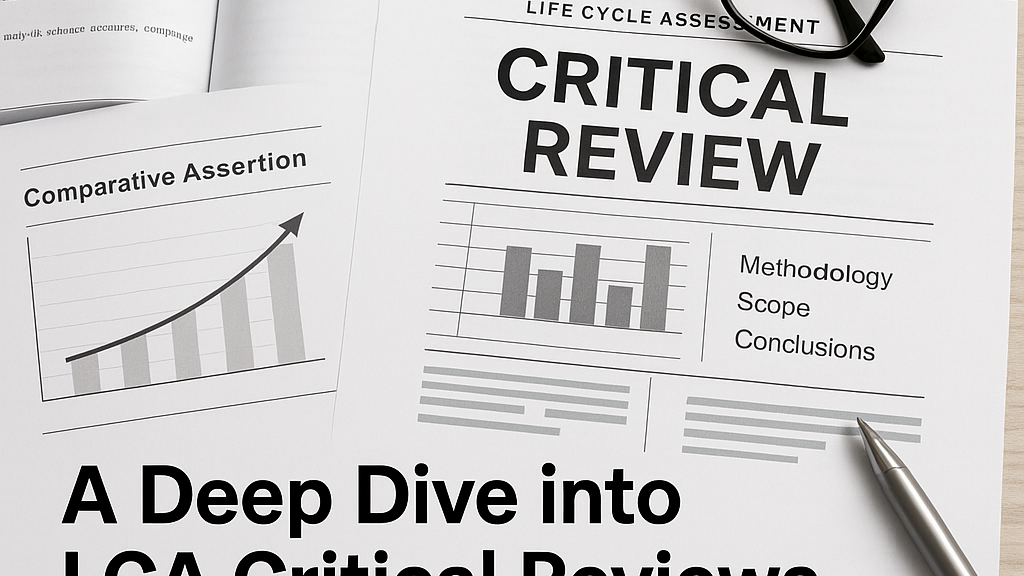
Expectations increase significantly when comparative assertions intended for public disclosure are involved. When a study claims that one product is environmentally better than another, ISO 14044, through Chapters 6.1 and 6.3, requires a panel-based critical review.
In such cases, a panel of at least three independent and qualified experts evaluates the study, including system boundaries, methodological choices, data quality, and interpretation of results. This process is demanding, but appropriately so, as public comparative claims must be robust, transparent, and defensible.
ISO 14044 leaves reviewer qualifications relatively open, referring only to independence and appropriate qualification. In practice, different review styles are often observed. Some reviewers focus deeply on methodological details, while others take a broader, systems-level view. Both approaches can add value when applied with sound judgement.
Challenges arise, however, when reviews become overly focused on issues that do not materially affect results or conclusions. The real value of a critical review lies in challenging the study where it matters most, rather than in generating comments for their own sake.
Requirements in comparative assertions?
Life cycle assessment sits at the intersection of scientific rigour and practical constraints. Standards such as ISO 14044 provide a strong framework, but they cannot anticipate every modelling situation, data limitation, or interpretative challenge.
As artificial intelligence and digital tools increasingly enter the LCA space, there is a risk that reviews become overly automated or checklist-driven. While such tools can support efficiency and consistency, critical reviews ultimately rely on expert judgement, particularly when assessing assumptions, trade-offs, and interpretation of results.
The future may involve a hybrid approach, but keeping experienced human reviewers firmly in the loop remains essential to maintaining credibility and trust in LCA outcomes.
The role of expert judgement and emerging tools?
The role of expert judgement and emerging tools?
Life cycle assessment sits at the intersection of scientific rigour and practical constraints. Standards such as ISO 14044 provide a strong framework, but they cannot anticipate every modelling situation, data limitation, or interpretative challenge.
As artificial intelligence and digital tools increasingly enter the LCA space, there is a risk that reviews become overly automated or checklist-driven. While such tools can support efficiency and consistency, critical reviews ultimately rely on expert judgement, particularly when assessing assumptions, trade-offs, and interpretation of results.
The future may involve a hybrid approach, but keeping experienced human reviewers firmly in the loop remains essential to maintaining credibility and trust in LCA outcomes.
Common misconceptions about critical review
One persistent misconception is that a critical review guarantees the correctness of numerical results. In reality, the review does not certify values as objectively correct, but evaluates whether results are derived from appropriate methods, reasonable data, and transparent assumptions. Another misconception is that a critical review removes all uncertainty. LCA inherently involves modelling choices and data limitations, and a good review acknowledges these rather than attempting to eliminate them. Finally, critical review is sometimes viewed as an obstacle to project delivery. When integrated early and approached constructively, it often improves study quality, reduces rework, and supports clearer communication of results to decision-makers and external audiences. This perspective helps organizations treat critical review as a quality assurance step rather than a compliance burden imposed late in the process.
Author note
Vijay Thakur is a sustainability and life cycle assessment professional with experience in LCA studies, critical reviews, and EPD-related work across multiple sectors. His work focuses on methodological rigour, transparency, and credible sustainability claims aligned with international standards.