
A closer look at Module B
Anyone who has worked on an EPD for even a short time knows that Module B, the use stage, is sometimes difficult to get right because the boundaries between sub-modules are often confusing, especially if you are a new LCA practitioner. This article focuses specifically on the mistakes that occur more frequently and are flagged during third-party verification and reviews, requiring a full rework. If you are preparing a Module B declaration or reviewing one, this is worth reading carefully.
4/1/20266 min read


A Quick Recap of Module B
Module B consists of seven sub-modules, each with a specific scope. The problem is that some of the modules sound similar enough to cause confusion for beginners:
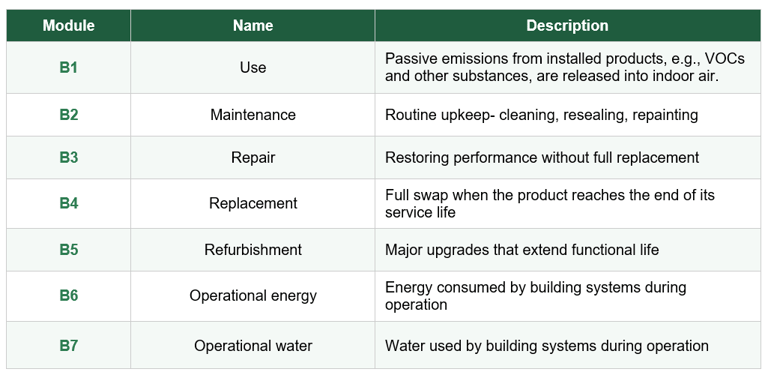
The Most Common Mistakes and How to Avoid Them
These are the errors that most often occur, and many of these are related to misclassification.
1. Confusing B1 with B6 and B7
The most common is B1 being left completely blank, as sometimes new LCA practitioners look at B1, assume that their product doesn't emit anything, and move on. But that's not how B1 works. B1 isn't just about obvious emissions; it's about anything a product quietly releases simply by being installed. No one needs to switch anything on. The product is just sitting there, and over time, something is being released into the environment. This is most critical for products such as coatings, sealants, flooring, insulation, and adhesives, where chemical emissions during service life are a concern.
So, before you mark B1 as blank, just stop and ask: Does my product release, leak, or emit anything just by being there? If the answer is yes, B1 needs to be filled in.
Similarly, some practitioners see that B1 sits within the use stage and report operational energy or water consumption there. That's a mistake. If a product needs to be running to consume energy, that belongs in B6. If a product uses water during normal operation, that goes in B7. B1 is passive only. Here are three examples:
An HVAC system consuming electricity while running is considered in B6
A cooling tower evaporating water during building operation is considered in B7
A floor coating releasing VOCs into the room over time is considered in B1
2. Mixing Up B2, B3, and B4
These three modules sit next to each other, sound similar, and are genuinely easy to confuse. But they describe fundamentally different activities and misclassifying them doesn't just affect one line item. Each module carries its own upstream production and transport burdens, so getting the classification wrong misrepresents the entire impact associated with that activity. Here's the distinction between these modules:
B2: Planned maintenance. Scheduled cleaning, resealing, repainting, and routine servicing. This work was anticipated and programmed. (e.g. replacement of a component after a fixed number of years).
B3: unplanned repair. A component fails unexpectedly and it's fixed or replaced reactively. Nobody saw it coming. (e.g., a certain percentage of tiles (2–5%) may crack over the reference study period and require individual replacement).
B4: full product replacement. The entire declared product is removed, and a new product is introduced at the end of its service life. This is required when the service life of the product is shorter than the defined Reference Service Life of the system where the product is installed. For example, if a product with an RSL of 15 years is installed in a building system with an RSL of 60 years, then it will require three replacements in the B4 Modules.
Another example is to consider a curtain wall system. The gasket fails unexpectedly and gets replaced, that's B3. The same gasket was replaced on a scheduled ten-year maintenance cycle that's B2. The entire curtain wall panel was removed and replaced at the end of life, which is B4. Same product has three different scenarios, and each one is assigned to a different module. The most common mistake is putting an unplanned component failure into B4, or putting scheduled maintenance activities into B3, which misrepresents the nature of the work.
3. Using the Wrong Service Life for B4 Calculations
Every product has a service life. In EPD terms, that single number decides how many times your product is replaced in Module B4 across the reference study period, typically 50 or 60 years. If it is incorrect, everything built on top of it is also incorrect.
This is where most manufacturers slip up, they assign a service life that reflects their confidence. "We're comfortable saying 40 years." But confidence isn't evidence. A verifier is not going to accept a number because it feels right; they will ask where it came from, what test or standard backs it up, and whether someone else could independently arrive at the same figure. If the answer to that last question is no, the number isn't verifiable. The reference service life shall be derived using the test standards, manufacture warranties, service life as defined in EN standards, BBSR tables, or a number derived using ISO 15686.
4. Modelling B6 with wrong boundaries
B6 covers operational energy use, B6 can represent the single largest contributor to life cycle greenhouse gas emissions. Incorrectly determining the system boundary can completely distort the results. One of the most misunderstood aspects of Module B6 in EPDs (per EN 15804 / ISO 21930) is the energy attributed to a product. The answer depends on a simple but important distinction: Is the product consuming energy to perform its function, or is it simply carrying/transmitting energy to serve another function?
For products that require energy to operate/perform their defined function, the energy they draw from the grid is considered in the B6 Module; examples include HVAC systems, lifts and lighting.
The second category of products includes those that transmit energy (passive products). These products do not consume energy to function; they simply carry or transmit energy. However, due to physical imperfections (resistance, friction, conversion inefficiency), some energy is lost in the process. Examples include: cables, pipes, transformers and switchgear. For these products, only the associated losses are considered in Module B6. Also, the reference scenario plays a significant role. The energy mix assumed, whether it is the national grid, renewables, or something else, can noticeably change the B6 results. It is important to ensure that this aligns with the Product Category Rules (PCR) requirements for your product category.
5. Getting the B7 with wrong boundaries
B7 covers water consumed by a building product or system during normal operation—the operational equivalent of B6, but for water instead of energy. Applying the same logic as B6 and energy, the starting point is: Does your product form part of a system that uses or conveys water during operation? If yes, B7 is almost certainly within scope. The boundary is not limited to just the water-carrying component itself it covers any water consumed, lost, or discharged as a direct result of the product doing its job.
Pipe: A pipe is the water equivalent of a cable. Its job is purely to convey water from one place to another. The water flowing through it is not attributable to the pipe but to the system or user. Therefore, if water is transmitted through the pipe, it is not B7, if any water is lost through leakage, it is B7.
A Tap: At first glance, a tap looks like a pipe —it is passive, and it just controls the flow. But a tap does not just convey water; it determines the flow rate through its design specifications. The flow rate is a product characteristic, regulated by standards and declared on the product label. So, the tap's design directly determines the amount of water consumed, making full flow volume attributable to the product → B7.
Cistern or Flush Reservoir: This is the clearest case. Unlike a tap, where flow duration depends partly on user behaviour, a cistern has a fixed, product-determined flush volume, typically 6 litres for a full flush and 3 litres for a half flush. This volume is defined by the product design and regulated under standards. There is no ambiguity here: The water consumed per flush is entirely a consequence of the product design. Modelling it in B7 is straightforward: flush volume × flushes per day × 365 × reference study period gives total operational water consumption over the product's life.
Final thoughts
The standards are reasonably clear about what each of Module B covers, what makes it difficult is that most people encounter it for the first time mid-project, under time pressure, without anyone senior to check their reasoning against. That is when classification errors happen. To conclude, before you model anything in Module B, write down in plain language what you think each sub-module covers for your specific product, and why. If you cannot explain it clearly in a sentence, you probably have not resolved it clearly enough in your model either.
Author -
Vijay Thakur
Pawan Kumar is a Sustainability Management student at the National Institute of Agricultural Marketing (NIAM), Jaipur, with an academic background in Agricultural Science. He brings academic and field-level exposure to sustainability and agri-based systems through practical training and project work. His interests include ESG, Life Cycle Assessment (LCA), and Carbon Accounting with a focus on developing data-driven insights and supporting responsible sustainability practices
Pawan Kumar
Vijay Thakur is a sustainability and life cycle assessment professional with experience in LCA studies, critical reviews, and EPD-related work across multiple sectors. His work focuses on methodological rigour, transparency, and credible sustainability claims aligned with international standards.